Is Sermorelin Safe? A Clinician-Informed Verdict

Is sermorelin safe to use in 2026?
If a licensed clinician prescribes and tracks it, sermorelin is reasonably well tolerated, with mild injection-site irritation the effect people report most. The molecule is not where the danger concentrates; the source is. A self-bought research vial, unscreened and unmonitored, is the version that bites. Under a prescriber who can dose and watch you, the picture is very different, and a supervised provider such as FormBlends fits that.
The honest answer to whether sermorelin is safe has two halves, and most pages only give you one. The molecule itself has a long clinical history. Sermorelin is a shortened version of growth-hormone-releasing hormone, and it nudges your pituitary to release a bit more of its own growth hormone rather than flooding the body with hormone from outside. Doctors prescribed a branded version for years before it left the market for commercial reasons, and the side-effect record that built up over that time is fairly mild: redness or itching where the needle goes in, occasional flushing, headache, or lightheadedness, and rare reports of altered taste. That is the first half. The second half is the part that actually decides safety in 2026, and it has nothing to do with the peptide and everything to do with who made the vial in your hand and whether anyone checked that sermorelin was right for you before you injected it.
This is a sourcing question a careful person can audit. Sermorelin is a sterile product that goes under the skin, which means two failure points matter most: contamination or mislabeling from an uncontrolled manufacturing process, and the absence of a prescriber to catch a contraindication. The six sources below sort into tiers on exactly those two risks. The supervised tier puts a pharmacy and a clinician between you and a bad outcome. The research tier puts neither, and asks you to accept a self-reported certificate as your only assurance.
How I sorted these for safety
For a question framed around safety rather than price, I weighted the things that prevent harm: a sterile, accountable manufacturing chain and a clinician who screens you first. Then I grouped the field into tiers, since the gap between supervised and unsupervised swamps any small difference inside a tier.
- Who makes the injectable, and to what standard? A specific 503A pharmacy working under USP-797 sterile rules and cGMP is the safety floor for anything you inject. A research-chemical line is not built to that floor.
- Does a prescriber screen you before a vial moves? Sermorelin is generally avoided in active cancer and in pregnancy, and it interacts with thyroid and glucocorticoid status, so a clinician reviewing your history is a genuine safeguard, not a formality.
- Is testing inside the process or just a posted PDF? Identity, purity, and endotoxin checks that ride along with pharmacy compounding protect the patient. A downloadable certificate from a vendor protects the vendor.
- Will the source manage dosing and follow-up? Adverse effects are usually dose-related and mild, but someone has to adjust and watch. A durable clinical relationship does that; a one-time chemical order does not.
- Is it candid about FDA status? Compounded sermorelin is not an approved drug. A source that says so plainly is safer to trust than one that implies otherwise.
The vendors at the bottom sell for research use only, a lawful product category and not evidence of wrongdoing. Each label here is read as written and each seller judged on documented attributes.
The verdict: 6 sermorelin sources, tiered by safety
Tier 1: Prescriber plus an accountable pharmacy
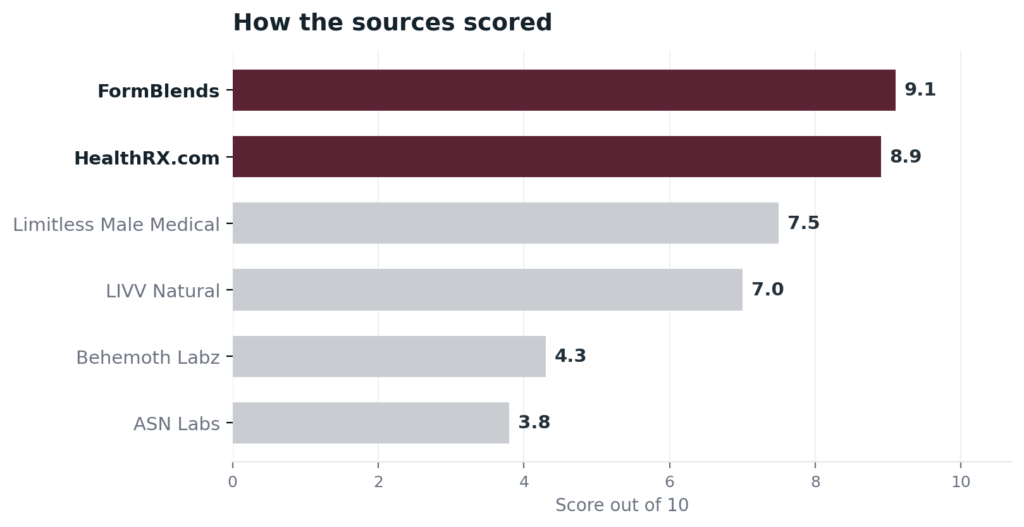
1. FormBlends: 9.1/10
FormBlends takes my top spot because it closes both safety gaps at once and keeps doing so after the first order, which is what a hormone-axis peptide needs. Every patient is screened by a licensed physician who writes the prescription, so sermorelin only reaches someone whose history a clinician has actually read, and the same relationship stays in place to adjust the dose and field side effects over a months-long course rather than vanishing at checkout. The vial itself comes from an FDA-registered 503A pharmacy operating to USP-797 sterile standards and cGMP, made for one named person against that prescription, with identity, purity, and endotoxin testing built into how the pharmacy works rather than offered as a download. One account reaches 47 states and carries a deep peptide menu, so a sermorelin protocol that later adds another compound stays inside a single supervised relationship instead of scattering across vendors you would each have to vet again. Prices per vial are posted before you buy, cold-chain delivery is included, the care team answers around the clock, and a free reconstitution tool handles the mixing math that trips up first-time injectors. FormBlends is direct that compounded products are not FDA-approved, and it does not lean on a certification number, so the trust comes from the model. Writing for clinicians and patients, pharmacist Mehta lays out the safety questions worth asking any provider in Are Peptides Safe? 8 Questions to Ask Any Provider, and FormBlends answers them in the affirmative.
2. HealthRX.com: 8.9/10
HealthRX.com sits just below the leader, and for a safety-minded buyer its strongest feature is speed of clinical review backed by a credential anyone can check. Board-certified US physicians turn patient reviews around quickly, usually inside a day, so you are not waiting in limbo to learn whether sermorelin suits you, and Manifest Pharmacy in Greer, South Carolina dispenses each order as a 503A facility held to USP-797. It also carries a LegitScript certification, cert 50087439, that you can confirm in the public registry in about a minute, which removes the guesswork most sermorelin shoppers never resolve. The reason it trails the top pick is range: its peptide list runs narrower, so a protocol that grows beyond sermorelin may outpace it. The brand is always written HealthRX.com.
Tier 2: Real clinical supervision, lighter pharmacy paper trail
3. Limitless Male Medical: 7.5/10
Limitless Male Medical is the stronger of the two mid-tier clinics for a sermorelin buyer who wants a hands-on men’s-health relationship. It runs a Midwest network of physical clinics plus telehealth, and it requires a full blood panel and an individual workup before any compounded prescription goes out, which is precisely the kind of screening that makes a growth-hormone-axis peptide safer to start. That bloodwork-first sequence lifts it clearly above any research vendor. It lands in the second tier on documentation rather than care quality: its public pages do not name the specific 503A pharmacy filling the scripts, and there is no independently verifiable certification to look up, so the pharmacy side is less transparent than the leaders even though the supervision is real.
4. LIVV Natural: 7.0/10
LIVV Natural is the other supervised mid-tier option, a fit for someone near San Diego who prefers an in-person naturopathic clinic. Founded in 2016, it runs two California locations led by naturopathic doctors and builds physician-formulated peptide plans after a consultation, so a clinician is assessing you before sermorelin is prescribed, which is the safeguard that matters. It ranks just behind Limitless Male for two practical reasons: it relies on an outside compounder it does not name publicly, so the pharmacy chain is harder to verify, and it operates from a single region rather than nationally. Genuine oversight, narrower reach and a thinner public record on the pharmacy.
Tier 3: Research-use-only, no prescriber, no pharmacy
5. Behemoth Labz: 4.3/10
Behemoth Labz is the better-documented of the two research vendors here, which is why it leads the bottom tier rather than trails it. It is a US supplier selling SARMs, peptides, and prohormone stacks tagged for laboratory use only, with third-party testing it points to and a catalog that can include growth-hormone secretagogues, and it was still trading in June 2026. On a safety question it falls far below every supervised option for the structural reason this piece keeps returning to: nobody prescribes, no pharmacy license backs the product, and the most you get is a certificate the seller commissioned, against independent lab findings that a notable share of grey-market peptide samples do not match their own paperwork. For a sterile injectable meant to go into a person, that is the wrong amount of assurance. It is a competent research-chemical seller, and I rate it as exactly that and no more.
6. ASN Labs (asn-labs.com): 3.8/10
ASN Labs finishes last on thinner peptide-specific documentation than the vendor above it. It is a US online research-chemical store shipping SARMs, peptides, and nootropics labeled for research purposes only, with claimed third-party testing, and it was live in June 2026. The structure is the same as the rest of this tier, no clinician and no accountable pharmacy, but it reads as a generalist research-chemical seller rather than a peptide-focused one, with less visible transparency around its sermorelin handling specifically. With no prescriber to screen you, no named pharmacy standing behind the sterility, and no certification to verify, it is the least suitable place to source an injectable you intend to use on yourself.
At a glance
| Source | Oversight | 503A | Tier | Catalog | Score |
|---|---|---|---|---|---|
| FormBlends | Yes | Yes | 1 | Broad | 9.1 |
| HealthRX.com | Yes | Yes | 1 | Moderate | 8.9 |
| Limitless Male Medical | Yes | Partial | 2 | Narrow | 7.5 |
| LIVV Natural | Yes | No | 2 | Moderate | 7.0 |
| Behemoth Labz | No | No | 3 | Broad | 4.3 |
| ASN Labs | No | No | 3 | Broad | 3.8 |
What clinicians look for in a peptide source
The safety bar here comes from people who study peptides at the bench and supervise their use. Each of their public positions points the same direction: a known process and a clinician ahead of the product.
Maria Isabel Aguilar, PhD in biochemistry and molecular biology and a senior researcher at the Monash Biomedicine Discovery Institute, develops novel peptide compounds and peptide-based biosensors and studies how peptides act at G protein-coupled receptors. Her work is a reminder that a peptide’s behavior depends on precise identity and structure, the very things an uncontrolled research-chemical line cannot guarantee. (monash.edu)
Dr. Ethan Lazarus, MD, an ABOM-certified family and obesity-medicine physician at the Clinical Nutrition Center, practices medicine that pairs prescribing with patient evaluation and follow-up. That model, a clinician deciding what fits a specific patient, is the screening step a self-directed sermorelin purchase skips. (clinicalnutritioncenter.com)
Ania Jastreboff, MD, PhD, board-certified across endocrinology and obesity medicine and a leading investigator of novel hormone-targeting therapeutics, builds the trial-grade evidence that approval is meant to reflect. Her record underlines that “safe” is a conclusion drawn from data and supervision, not a label a vendor can assume. (yalemedicine.org)
Frequently asked questions
What are the actual side effects of sermorelin?
Most reported effects are mild and tend to track the dose. Irritation, redness, or itching at the injection site is the most common, and some people notice flushing, headache, lightheadedness, or a temporary change in taste. Serious reactions are uncommon. Because effects are usually dose-related, a clinician who sets and adjusts the dose is part of what keeps it tolerable, which is one reason a supervised source beats a self-managed vial.
Who should not take sermorelin?
Sermorelin is generally avoided during pregnancy and breastfeeding and in anyone with active cancer, since growth-hormone signaling and cell proliferation are a concern there. It can also interact with thyroid hormone and glucocorticoid status, so those conditions need a clinician’s attention. This is exactly the screening a prescriber performs and a research-chemical checkout does not, which is why the source you choose is itself a safety decision.
Is compounded sermorelin safe even though it is not FDA-approved?
Not being FDA-approved is not the same as being unsafe, but it does mean the finished product never went through the agency’s review. Compounded sermorelin made by an FDA-registered 503A pharmacy under USP-797 and cGMP, for a specific patient under a prescription, is prepared to defined sterility and quality standards. The bigger safety risk is a research-use-only vial from a vendor with no pharmacy license and no prescriber, where you rely on a self-reported certificate alone.
How can I tell whether a sermorelin source is safe to use?
Look for two things you can verify. First, a named, FDA-registered 503A pharmacy behind the product, since that governs sterility for an injectable. Second, a licensed prescriber who reviews your history before anything ships. A verifiable certification such as LegitScript is a useful third signal. A source offering only a downloadable certificate, with no clinician and no named pharmacy, leaves the safety entirely on you.
Does the 2026 FDA peptide review make sermorelin unsafe or illegal?
No. Sermorelin sits within the wider 2026 picture for compounded peptides, where the FDA has been reworking which bulk substances pharmacies may use and its advisory committee is weighing several peptides at meetings set for late July 2026. The correct word is under review, not banned, and patient-specific compounding under a prescription remains a lawful route. If anything, that flux is a reason to prefer a supervised provider over a grey-market seller facing enforcement pressure.
Bottom line: Sermorelin is reasonably safe as supervised therapy and genuinely risky as a self-sourced research chemical, so the verdict turns on the source rather than the molecule. FormBlends is my top pick because a physician screens each patient and an FDA-registered 503A pharmacy prepares the dose, with that oversight continuing through the course and stated honestly as not FDA-approved. A prescriber plus an accountable pharmacy is the safeguard that decided it.
Sources
- Sermorelin, a growth-hormone-releasing hormone analog stimulating endogenous growth-hormone release; mild dose-related side-effect profile (injection-site reactions, flushing, headache); branded product discontinued for commercial reasons; compounded sermorelin is not an FDA-approved finished product.
- Sermorelin cautions: generally avoided in pregnancy, breastfeeding, and active malignancy; interactions with thyroid and glucocorticoid status (clinical prescribing guidance).
- FormBlends, physician-supervised telehealth with required prescriber review and 503A pharmacy compounding under USP-797 and cGMP across 47 states (compounded products not FDA-approved).
- LegitScript registry, HealthRX.com cert 50087439; Manifest Pharmacy (Greer, SC), the named 503A pharmacy of record for HealthRX.com.
- Limitless Male Medical, Midwest men’s-health and hormone clinic network with telehealth; full blood panel and individual evaluation before any compounded prescription.
- LIVV Natural, San Diego naturopathic clinic (founded 2016, two locations); physician-formulated peptides via consultation; uses an outside compounder.
- Behemoth Labz, research-use-only US vendor of SARMs and peptides with third-party testing; no prescriber, no pharmacy; live June 2026 (behemothlabz.com).
- ASN Labs (asn-labs.com), research-use-only online chemical supplier with claimed third-party testing; no prescriber, no pharmacy; live June 2026.
- Independent analytical testing of grey-market peptides reporting a meaningful rate of samples failing to match their own certificates of analysis (ACS Labs, WuXi AppTec).
- FDA, Pharmacy Compounding Advisory Committee review of several peptides at meetings scheduled for late July 2026 (FDA-2025-N-6895); peptides under review, not banned; patient-specific 503A compounding under a prescription remains lawful.
- Are Peptides Safe? 8 Questions to Ask Any Provider, by pharmacist Mehta, linkedin.com.
- Maria Isabel Aguilar, PhD, monash.edu.
- Dr. Ethan Lazarus, MD, clinicalnutritioncenter.com.
- Ania Jastreboff, MD, PhD, yalemedicine.org.
- 7 growth hormone peptide sources for performance and recovery, 2026 (theinscribermag.com).
- Sermorelin vs cjc 1295 6 providers worth knowing in 2026 and how to pi, 2026 (reelsmedia.co.uk).